Starting from 2010, Neva-Magnit S&E participates in an International Project of a new accelerator complex Nuclotron based Ion Collider fAcility (NICA) which is under implementation at the Joint Institute for Nuclear Research (Dubna, Russia) and underlies the “NICA Complex” megaproject. The complex NICA is designed to study properties of dense baryonic matter. The multipurpose detector (MPD) in the NICA accelerator complex is a 4π spectrometer to be used for studying charged hadrons, electrons, and photons generated in heavy ion collisions at energies provided by the NICA collider.
A constituent part of the MPD detector is a superconducting solenoid magnet with a superconducting NbTi coil and a steel flux return yoke. The superconducting magnet of MPD is intended for providing a highly homogeneous magnetic field of 0.5 T in an aperture 4596 mm in diameter to ensure the transverse momentum resolution within the range of 0.1–3 GeV/c at NICA. For this, the integral of the radial component of the magnetic induction in the cylindrical volume of the TPC (Time Projection Chamber) must be <0.775 mm, and the field uniformity in this region should be better than 10-3.
In 2012 the specialists of Neva-Magnet prepared sections of the Conceptual Design Report of Multipurpose Detector (MCD) related to the Superconducting Detector Magnet (The Multi-Purpose Detector – MPD to study Heavy Ion Collisions at NICA). Later, in 2015, Neva-Magnet completed the development of the Technical Design of the magnet (Multi-Purpose Detector Solenoidal Magnet. Technical Design Report). The construction of the cryostat with superconducting winding is carried out at ASG superconductors (Italy). Neva-Magnet follows up on the solenoid construction.
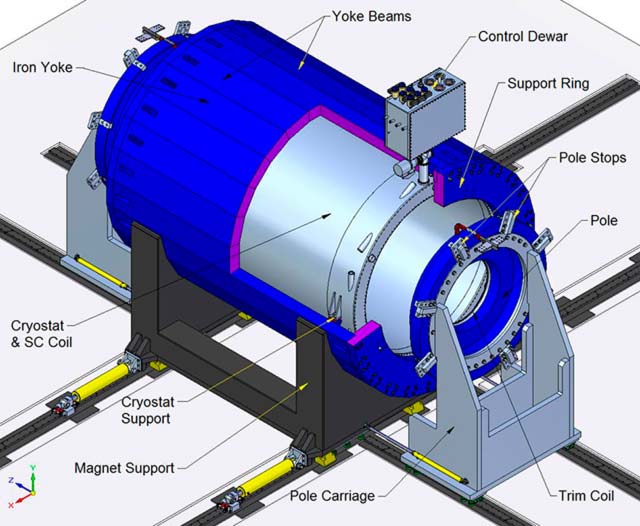
The MPD magnet consists of:
-
A cryostat with a superconducting coil and a control Dewar
-
A flux return yoke
- Magnet support cradles
The superconducting coil placed in the cryostat is a "single-layer" solenoid made of a superconducting niobium titanium conductor in an aluminum matrix with a bare cross section of 4.1х20 mm2 (the insulated conductor cross section is 4.5х20.4 mm2). The conductor is manufactured by co-extrusion of stabilizing high-purity aluminum (purity 99.998%, RRR>1000) and a superconducting NbTi wire 1.73 mm in diameter (Cu/SC ratio =0.9/1). The coil is wound onto the inner surface of the aluminum support cylinder.
A distinctive feature of the solenoid is that the main superconducting coil has no correcting coils at its ends. Maintaining the needed field distribution in the operative area of the magnet is provided by two trim coils mounted on the pole tips.
Structurally, the MPD magnet yoke is a cylindrical barrel-like structure, which consists of 28 beams that return the magnetic flux of the coil, two support rings, two poles, and two support cradles that carry the total weight of the detector. The support rings are made as single forged pieces. Two end caps installed within the support rings form a magnet poles equipped with the trim coils. In general, the adopted structural arrangement of the yoke guarantees high rigidity of the whole magnet and will ensure the required field homogeneity and integral of the radial magnetic induction component in the TPC region after subsequent withdrawals of the poles and multiple movements of the magnet to the assembly site for updating or repair.
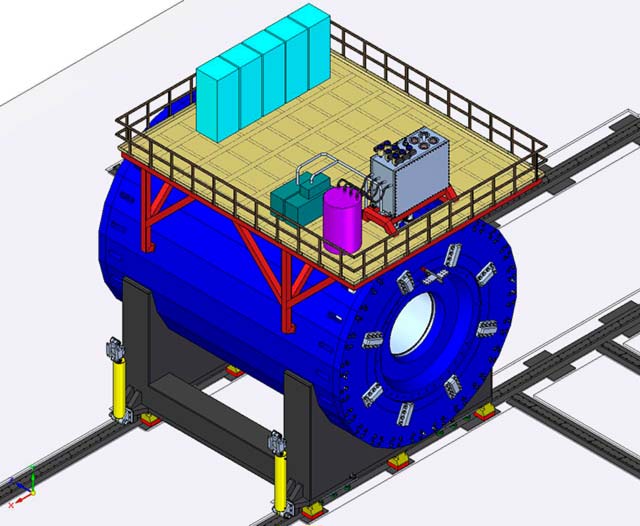
When being assembled and when installed in the accelerator, the magnet rests on ten stationary supports. Roller skates and rail tracks are used for moving it with the cryostat and inner detectors from the assembly site to the operating position. The magnet will be moved along the rail track using two bidirectional hydraulic cylinders.
A control Dewar is installed on the top platform. It is connected to the cryostat by a demountable connecting pipe (Chimney) through the slot in the upper barrel beam. The control Dewar is connected to the forward and backward liquid Helium and Nitrogen pipelines by bayonet-type joints on its side wall. The top plate of the control Dewar is supplied by the terminals of the gas-cooled current leads to which the SC coil power supply is connected, relief valves, and other valves and electrical connectors.