

In 2003-2015, Neva-Magnit S&E took part in the international project FAIR (Darmstadt, Germany) under the contract with the Joint Institute for Nuclear Physics (Dubna).
Within the framework of this project, a HESR (High Energy Storage Ring) storage ring will be constructed for antiproton energy up to 15 GeV/s. In the planned experiments on the structure of hadrons and spectroscopy of hypernuclear collisions, it is supposed to use a multi-purpose detector developed by the international collaboration PANDA (Proton Antiproton Detector Array).
The main component of this detector is a superconducting solenoid, which is characterized by a warm hole of 1.9 m in diameter, a field value in the working region of 2 T, and stored energy of 21 MJ.
In the region occupied by the central tracker there are stringent requirements on the magnetic field homogeneity. The absolute magnitude of the field must not vary by more than 2% from the nominal field of 2 T over the whole tracker region. Furthermore, the radial component of the magnetic field Br must remain as low that any integral along z to the central tracker read-out plane, located at z = −400 mm, results in a value below 2 mm.
The PANDA magnet consists of a cryostat with a superconducting winding and a flux return yoke. The yoke includes the following main components:
- yoke "barrel" formed by eight modules (beams)
- two end caps (doors), each of which consists of two wings
- two collars of the space support frame
- two beams of the magnet platform
The superconducting coil of the solenoid is wound by NbTi cable in an aluminum matrix with a purity of 99.998% and RRR> 1000.
The cryostat comprises the cold mass with the superconducting coil surrounded by a thermal screen and suspended on low heat conduction ties. It is mounted on four support legs fixated on the inner surface of iron yoke barrel. Control Dewar mounted on the top of the yoke is a functional unit of the magnet cryogenic system. It is intended to maintain the required parameters of cryoagents and to provide cooling of the current leads. Cryogenic supplies and current supplies will be connected from a control Dewar to the cryostat through the service Chimney. In the bottom part of the Chimney an interface box is located, which is intended to accommodate connections of cryogenic pipelines and current bus bars from cryostat and control Dewar.
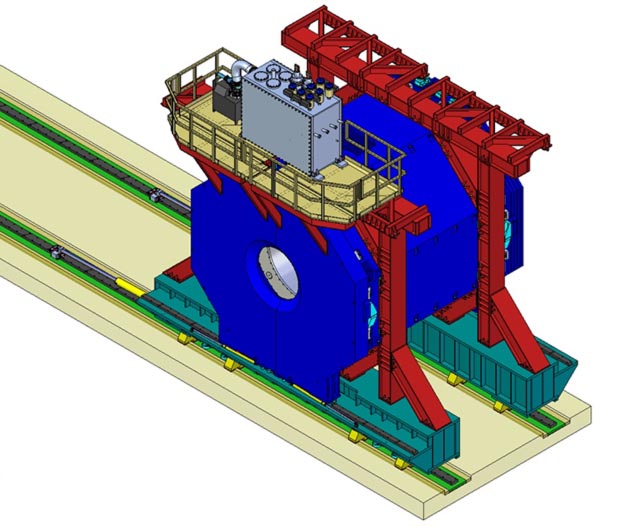
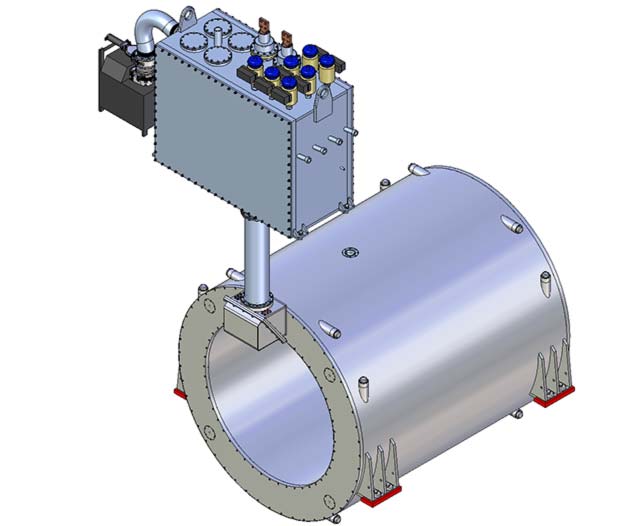
The cooling method chosen for the Panda magnet superconducting coil is based on the natural convection of liquid helium flow. It is self-regulating thermosyphon circulation flow system. Natural circulation loop works on the principle that a heat load on channels of the heat exchanger produces a two-phase flow that is on average less dense than the liquid phase.
The liquid from the helium vessel of the control Dewar will be fed through the forward pipeline and manifolds at the bottom of the support cylinder. Then the liquid will be heated in the tubes of the heat exchanger (a rib cage configuration) on the surface of the support cylinder. The two-phase helium from top manifolds returns back through the reverse pipeline to the upper part of the helium vessel.
Liquid helium that is used for cooling the cold mass is fed from the liquefier at 4.5 K. Thermal shields of the solenoid surround cold internal parts and are cooled by gaseous helium which passes through a pipe of the heat exchanger of serpentine type. Helium flow leaves the Liquefier at temperature level 40 K and returns to the Liquefier after thermal shields at temperature level 80 K.
The cold mass of the cryostat is suspended on four vertical rods. Eight horizontal tie rods of radial suspension fix the cold mass against the shifts under action of decentering magnetic forces and seismic loads in lateral direction. Eight axial tie rods hold the cold mass against its shifts due to decentering axial magnetic forces acting both in the cryogenic input direction and in the opposite one, as well as against the seismic loads acting in axial direction. The position of the cold mass in axial direction is fixed in the area of the hole for target (fixation point is placed unsymmetrical with respect the cryostat center). All tie rods are made of high-strength alloy Inconel 718 .
To reduce the bending stresses in the tie rods when they work in cold state, they should be pre-bended in warm state. It would be expedient to do it for the horizontal rods of the radial suspension after installation of the cold mass inside the cryostat. Pre-bending procedure will be performed by rotation of an eccentric sleeves in the heads of suspension rods.
In 2016, according to a contract with JINR, Neva-Magnet completed the development of the Technical Design of the PANDA magnet (iron yoke, cryostat, cooling system). The documentation was transferred to the manufacturer of the PANDA magnet - the Budker Institute of Nuclear Physics of SB RAS.